Thursday, December 8, 2011

Making the Impossible Possible

Linda Taylor

I truly never thought I could do it. Sure, I’ve been in the professional field for many years—writing and reading book proposals for our publishing outsource company, editing, copyediting, proofreading. When I began my master’s program lo these many years into my life, I wanted to understand more about what drives me, why I do what I do, and how, in the process of reviewing proposals and manuscripts for my day job, to be able to put my finger on what works and what doesn’t—and why. In short, I needed what my new country friends would call a cattle prod.

What did I think I could never do? I thought I could never write a novel, sustain a storyline, weave a tale. I edit, after all, so that means cut cut cut—rarely add add add. How does a writer take a story and make it last for 200, 400, 800 pages? (Thank you, J. K. Rowling, for raising the bar on me.) How does a writer weave a tale that keep the pace, cause readers to invest in characters, create an arc that keeps readers turning pages, and then, at last, provide a satisfying ending?

How?

I saw it as an impossibility.

Then I took Professor Cathy Day’s Fiction Writing Class. She’d be thrilled if I told you that after one semester I answered all of the above questions, mastered the techniques, and wrote the great American novel. But she also wouldn’t want me to lie. What she did for me, however, was teach me to write a novel by giving me a bite-sized assignment: “Write a set of stories that link.”


I can do that.

I can sustain a story for maybe twelve pages. I can work on characterization so that my readers know one protagonist well and resonate with him or her.

So write a story.

Okay, now write another.

Okay, now write a third.

Make them link. Have an overarching theme that ties these stories together—location, relationships, whatever. Interweave a plot line.

I can do that.

Then I had 25 pages and wrote to Cathy in dismay, “I’ve written 25 pages and nothing has happened!”

Cathy suggested that I use the storyboard technique we talked about and worked on in class. Out come the index cards. Write out each scene. Rearrange. See what happens.

Enter the plot line. Only trouble is interesting. Create trouble. With guidance from Cathy and the help of Michelle Hoover’s “Plotting Your Novel,” I studied my key characters in each story. What do I know about these characters? What is their flaw? What do they want? What will happen if they don’t get it? What then? How will the characters react? Get inside the characters, in their “souls,” as Cathy would say.

Go back to my index cards, noting these elements along with the characters in each scene. Are they acting as they should? Is this scene advancing the storyline? Are my characters real and sympathetic (even the bad ones) or mere caricatures?

Get hung up on the details.

Experience frustration.

Stop writing for a day or two and decide it’s impossible.

Cathy encourages, “Just keep writing. Don’t get hung up on the details. Just get it all out of your head and down on paper.”

So I begin to bang away at the keys until I have a story. Fill in the blanks. Keep typing. Don’t worry about inconsistencies. That’s what editing is for. It’s not polished. Not perfect (I hate that). Not fully realized. Lots of flaws (I hate that, too). But keep going. Get it written. Take my characters’ desires and stir up some trouble (hey, this is fiction—anything can happen!), and see what they do.

After getting it down, it’s time to go back and revise (that I do know how to do—edit, cut cut cut, shape, focus). Whose POV is the focus in each story? Am I staying consistent? Are the links making sense—that is, are my characters interacting naturally or does anything feel forced? (Just because anything can happen in fiction doesn’t mean suspending belief.) Is the dialog believable?

I’m at 63 pages now—I know, not anywhere near the great American novel. But I can turn in a nicely polished assignment. But beyond that, you know what? I know that with my little story, there is so much more yet to say. So much more to explore with my key characters along with some minor characters. Backstory to create. Other plot lines to discover.

Don’t get me wrong . . . this is hard work. But I can begin to see it now—how a writer weaves a tale, sustains a storyline, creates and builds interest. And the more work I do, the more I appreciate those who’ve gone before me and written the great books we still read today. It’s sheer brilliance.

And maybe, just maybe, I can do it.

Tuesday, December 6, 2011

Tricked into Writing a Novel


This semester was my first foray into writing linked stories, which at the beginning felt like a completely new form from anything I’d ever attempted before. And that might be a more appropriate word than “foray”—attempt. We read several examples of linked stories as a class; some felt more like short story cycles, while others felt more like novels. We read Winesburg, Ohio, Mrs. Bridge, Please Don’t Come Back From the Moon, and A Visit from the Goon Squad. We defined “linked stories” as stories that fit together, but could also stand alone individually. Not quite everything we read fit into this model completely. For example, sometimes a piece of what we read might not stand alone well, and so it would read more as a chapter of a novel than a story in a series of linked stories.


Whenever we talked about something we had read, we would talk about where it might fall on the scale of short stories vs. novel. Several times, we literally drew a line on the chalkboard with “short stories” at one end and “novel” at the other. We would then place whatever title we had just read wherever we thought it fell on the line, usually closer to one end then the other. No book fell right in the middle. For example, Winesburg read more like short stories, and Please Don’t Come Back from the Moon, more like a novel. While this was theoretically a good illustration for what we were learning, the fact that none of our reading fell perfectly in the middle into its own classification of “linked stories” made understanding this new form somewhat more difficult for me, especially when the time came for me to begin writing my own.


I began my linked stories full of trepidation. I had a setting, a discount movie theater, and a few characters in mind, but I was terrified that I would not be able to “link” my different storylines effectively. When I finally began writing, however, my characters and stories seemed to “link” together almost magically, without me even trying. In fact, I did not even notice the “linking” going on in my stories until workshop, when my classmates pointed out that my characters and their stories were linked not only in their common workplace, but also within their interactions.


Although when I looked over what I had written, I began to worry that something more closely resembling a novel was evolving on my computer screen. Then I was worried that what I was writing was not actually linked stories, but chapters of what was becoming a novel. This was a problem I had not anticipated. When we came together again as a class, I found out I was not alone, but that others in my class were also concerned that their work was more resembling a novel or short story cycle, and somehow this form of “linked stories” was eluding us. We eventually came to the earth-shattering conclusion that we were going about this in the wrong way. Linked stories is not necessarily a form off on its own, but it is a way to write a series of short stories or a novel. As our professor told us that day—she’d tricked us into writing a novel.

From Storyboards to Novel: How I learned to write a novel using a linked-story approach


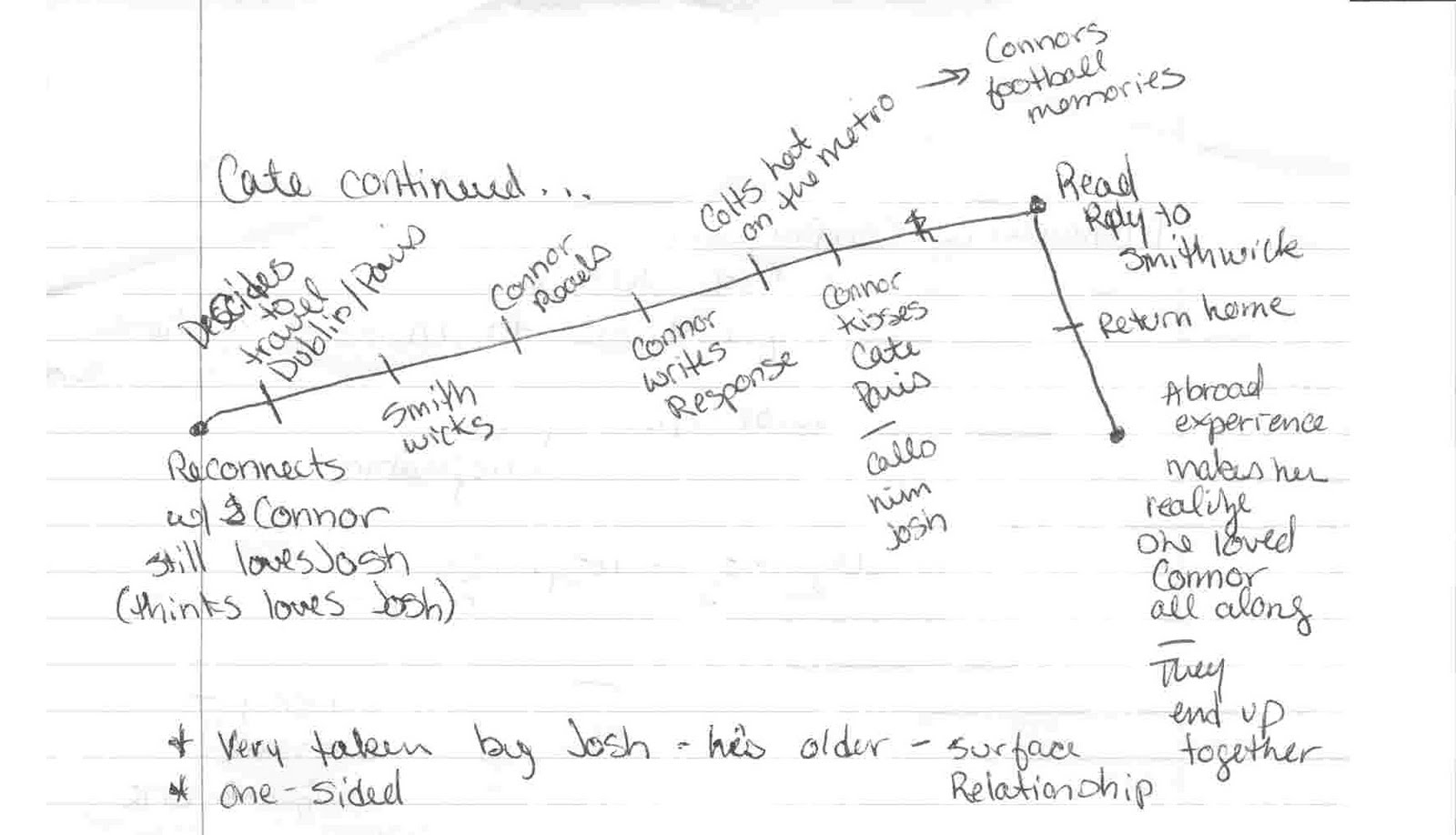
My initial goal was to write twenty-two, linked-story vignettes revolving around three main characters: Cate Porter, Natalie (Nat) Roberts, and Connor Braun, who are brought together on a college-sponsored, study-abroad trip to England. I had the basics of the story, but my challenge was how to manage the each character’s vignettes. To accomplish this overwhelming task, I did two things. First, I broke each character’s story arc down into individual storyboards. Second, I wrote out what each character wants; what happens if they do/don’t get it; what was at stake for each person; and as a result of the first three questions, what would happen next. Once the planning was done, I started writing my linked stories, and quickly discovered that the form of linked vignettes was not working. I tried to write through this complication, and in doing so I found that the novel form emerged instead of a series of twenty-two separate vignettes.

My first chapter is an instance where I used storyboards and a linked-stories approach. The chapter begins with Cate’s first-person narration of arriving at the airport, having a drink at the bar with her mother, and what she wants from this trip. While at the bar she notices travelers around her, specifically a blonde girl across the bar. The next section of the chapter is told from Nat’s perspective. From her seat at the bar, she narrates her day’s events up to that point, fills the reader in on her fear of flying, and notices Cate and her mother across the bar. She is also the first to see (from the bar) Connor walking through the airport. Finally, Connor arrives at the airport and explains his feelings for Cate, who is his older brother’s ex-girlfriend and the girl he is in love with. Additionally, Connor narrates the first interaction between him and Cate at the gate and together they are introduced to Nat at the gate via the trip director’s roll call. Having the individual, visual story arcs allowed me to see more easily where each character’s story touched one another. I use those points of connections to link their stories in the first chapter and will continue to do so through the novel. For example, the point at which Nat’s story and Cate’s story is overlapped is the reason why Nat’s story is rooted at the bar.

Prior to this I haven’t written any fiction, nor have I written anything longer than 30 pages. Taking the time to do individual storyboards and think about where and how the storylines linked, as well as articulating the answers to the four questions I mentioned above, allowed me to have a clearer focus. I’m psyched to see how my novel will turn out and I know I would never have obtained the momentum I have now without using storyboards and a linked-story approach.

Thursday, November 17, 2011

Linking Stories are Like Legos

(By Tyler J. Petty)


Endings are always difficult to write. It’s almost impossible to include everything you want to have in a story, and the process of deciding what really needs to be there versus what I want to have in the story can be enough to make me want to abandon the project altogether. And all of that comes before the question of how I’m going to organize the story so that the thing I want to finish with (assuming I even know what that is) actually comes at the “end” of the story.

As difficult as all those issues are to navigate when you’re working with a single story, the process becomes even more complicated when you’re writing a series of linked stories. With the linked stories I’m working on right now, I have to figure out what I’m going to do with all of those issues and possibilities for each individual story, and at the same time, keep in mind how each story fits into the overall narrative I want to tell, which stretches across all of those stories.


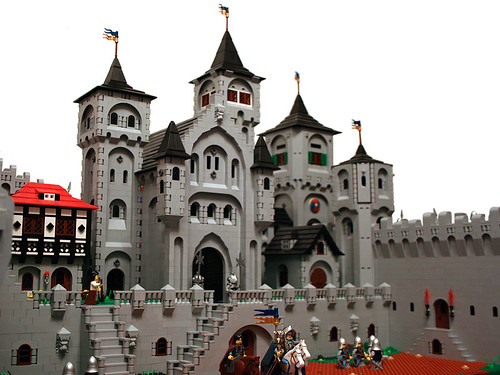
It’s like I have ten sets of Legos. Each one has its own composite pieces that fit together to construct a pirate ship, castle, or space station, and each set is internally complete. That is, I don’t have any leftover pieces when I finish the pirate ship. As I’m building the individual sets, however, I decide that I want all of them to connect together and form a much larger set that incorporates all the castles and space stations, and that also combines a new, unified super-set. And I have to do combine them in a way that doesn’t make the super-set look like a Frankenstein’s monster of mismatched pieces.


The way I see it, that is the largest difficulty in constructing a series of linked stories: Ending each story so that it’s complete, but also feeds into the other stories around it and allows room for them to connect and cohere into a larger whole.

One approach that has helped me with the series of linked stories I’m currently writing is the decision to write all of them in first-person. That has allowed me to use the limitations and gaps in a given character’s awareness as sockets into which I can fit the perspective of a different character, which then helps to clarify the previous story, while at the same time branching off and becoming a story of it’s own.

For example, the first story in my series, “Thirteen Little Words,” is narrated by Jenna, a fifteen-year-old girl who lives with her single mother. Jenna has a collection of books in which she and her father wrote notes and comments while they read them together. Jenna’s father is now out of the picture, so she uses the books, such as A Little Princess,  as a substitute for him:

Miss Minchin was quite agitated. This was an incident
which suggested strange things to her sordid mind. Could
it be that she had made a mistake, after all, and that the
neglected child had some powerful though eccentric friend                        
in the background—perhaps some previously unknown                        Trace mine, Dad.           
relation who had suddenly traced her whereabouts, and                        I’d take anything
chose to provide for her in this mysterious and fantastic way?             from you.


Jenna’s collection has expanded beyond just the books from her father, however. She also has a collection of fairy tales with a set of notes in them. She discovers the fairy tales previously belonged to Harold, a man she meets at the local park. When Jenna offers to give the fairy tales back to Harold, he refuses, saying, “My days with this book are over.” Harold then exits the story, while Jenna continues to narrate it.

Harold narrates the next story in the collection, “An Echo of Better Days,” which explains how and why he wrote those notes in the fairy tale collection, and also why he chose to give it away. In that story, Harold also mentions a waiter at the local French restaurant named Charles; the next story, “Poulet avec Legumes,” is narrated by Charles.

Using these sockets has helped me to think of each story as a separate entity, with its own plot and narrative arc, while also keeping my out for the “open spaces” I can use to fit the stories together, building them up into a creation that maintains the integrity of all the individual pieces, but also combines them into a new, unified structure.


Wednesday, September 28, 2011

Reverse Storyboards

by Cathy Day


In order to get my students to think about moving from writing small, disparate, individual things toward big, unified, linked things, I've been having them use a technique I call "reverse storyboarding." 

Basically, they take the book we're studying and--in any way that makes sense to them--thumbnail the chapters or stories, then display and talk us through their reverse storyboard. I told them: It can be on paper (post its, index cards, posterboard, drawn on blackboard) or digital (via Scrivener, Corkboard.me, linoit.com, a website, Prezi, etc.), but it must be visual and there must be some logic to how you arrange it so that we can “see” the entire structure of the book. 

These are my students, and these are the questions I wanted them to consider as they engaged this activity: 

Aubrie Cox used a mobile to create a three-dimensional grid
in order to talk about the structure of A Visit from the Goon Squad. 
What can I learn about how to write my own book from reading this book? What did I learn from the activity of storyboarding the book in reverse? (I'm going to let them answer that question in their own posts.) 

John Bahler used butcher paper to chart
the character subplots in Mrs. Bridge.
What is its formula? It’s map or blueprint or logic or “scaffolding” (a wonderful term used by Sean Lovelace). 

Tyler Petty created a website to create a chronological timeline for each character in A Visit from the Goon Squad. Find it at http://goonsquadtimelines.weebly.com/ 
How did the author sustain both long and short story arc? How did she move the project from short story collection toward novel?

Sarah Grubb tracked change in Dean Bakopoulos's Please Don't Come Back from the Moon, dividing her list into categories (concrete vs. abstract change, potential or desire for change vs. unrealized dreams, etc.) and displaying those categories as phases of the moon. 
What principle determines the book’s structure or chaptering? What is a chapter? What is a story? What makes a chapter feel like a chapter and not a scene?
Heather Gemmen Wilson used corkboard.me to keep track of every time Mrs. Bridge
said she'd do something--but didn't do it. Obviously, this happened a lot. 

How does the book juggle the different subplots within the structure it’s chosen? How do you make sure that each subplot has its own arc—beginning, middle, end? Imagining that a novel is like a season of a TV series, does the book develop all the subplots each episode (like Friday Night Lights or Mad Men or Glee, for example) or does the book tend to focus on one subplot or character each episode (like LOST, for example).

In this book, how does the arc of each story compare to the arc of the whole book?

Kat Greene used Prezi to re-shuffle the stories in Winesburg, Ohio.
How does the book keep the reader turning pages? What major dramatic questions are in my mind as I read? What keeps me in suspense, and how did the author create that suspense?

For Linda Taylor, the tornado scene in Mrs. Bridge
became a way to organize the different vignettes in the book--tornadic-ally!
Why this way and not another way? Or how would different narrative decisions, different orders, produce different effects?

Stacye Cline used CDs that looked like albums to talk about
the circular structure of A Visit from the Goon Squad.
Can I find out from author interviews how the book was written? Did the author write the stories/chapters in the order in which they appear in the book, or did she write them as they came to her and assemble them later? Which method will work for me so that I can avoid getting stuck, confused, overwhelmed by a big project? 


(My apologies to Josh Flynn and Katie Iniech, who presented on Please Don't Come Back from the Moon the night that my camera/phone was on the fritz. I'll get their reverse storyboards up later!)


I found these presentations fascinating, and I think my students learned a lot about linking from this process of unlinking, relinking, reshuffling, rebuilding, straightening, unstraightening, charting, color coding, encapsulating--which forced them to notice things they might have missed otherwise. 


Now, they are getting ready to workshop their own linked stories, and they're not reverse storyboarding anymore. They're charting their own course now. 


Wednesday, September 21, 2011

Lessons in Structure from Mrs. Bridge

Evan S. Connell takes an uncommon approach to structuring his “novel” Mrs. Bridge, and, in doing so, he gives his readers an opportunity to consider a fundamental craft question: What does (or can) the structure of a story accomplish? Or, what is the function of the form?

Mrs. Bridge is a composite novel told as a series of 117 very short stories in the life of the title main character, each story giving a glimpse into her character, the lives of her friends and family members, and the distant and fragmented nature of her relationships with those people in her life. Any reader will make strong connections between these stories, and will eventually piece together a storyline for Mrs. Bridge’s husband, her son, her two daughters, and several of her society friends.

Connell could have easily structured this book differently and included all of the same content. For example, instead of a composite novel, he could have written a linked short story collection. One story would be about Mrs. Bridge’s husband, one about her son, and one about each of the other major characters in her life. In a sense, this is the way the reader approaches the book anyway, tracing these storylines separately from one another—at least that was the natural way for me to read it.

If it had been written as a linked story collection, the pervading themes of loneliness, isolation and social decorum would have eventually emerged. In each story Mrs. Bridge would be unable to connect with those around her in a meaningful way, and we would get the sense that she is immersed in a world of loneliness even among friends and family.

But Connell’s chosen structure, the composite novel in 117 story-like chapters, adds or rather emphasizes another theme or another layer in those themes already present. This is a theme of fragmentation and a type of detachment that is more stunning than mere loneliness and isolation. The constant ending of a chapter and beginning of a new one removes the sense of immersion in a world of loneliness and replaces it with a sense that Mrs. Bridge is not immersed in anything or anyone. She has a brief interaction with someone, and her actions are determined neither by the desires of her own heart nor the emotional life of the person with whom she is interacting, but are based instead on a set of social mores that is blind to humanity and true human relationships.

The structure of Connell’s book dips into an interaction and then withdraws. It returns to a similar interaction with the same characters later in the book, but in a manner that is detached, oblivious to the meaning of the previous encounter. For Mrs. Bridge, interactions happen in isolation, in a fragmented world of unrelated experiences. As a result, it is a total mystery to her that other characters can even have genuine relationships with one another.

The fragmented structure—the structure that disallows immersion in any person or storyline—adds a profound shallowness to Mrs. Bridge’s character and her experiences, a shallowness that stems from her failure to touch the reality of human life around her, from investing in it and immersing herself in it.

Could Mrs. Bridge have been a successful book if written in a different form? Quite possibly so. But it would have failed to capture something of her experience of time and reality that is present in the fragmented structure that Connell chooses. Connell’s form walks us through the themes of Mrs. Bridge’s life, and through the way in which she experiences life. It is every bit as meaningful and as functional as Connell’s best irony, his saddest tale, and his truest image.

Friday, September 16, 2011

Give characters life a few words at a time

Evan S. Connell’s 1959 novel, Mrs. Bridge, is a characterization textbook for writers of all experience levels. Throughout the book, Connell focuses on the title character’s relationships with family and friends as well as her reluctance to achieve personal growth. The reader witnesses Mrs. Bridge attempt to present a public image that doesn’t draw attention towards herself and her family. At times, the reader glimpses her genuine emotion and concern.

What makes Connell’s character study so impressive is that he explores the Mrs. Bridge character using short vignettes. Many of the book’s chapters could be what we call today flash fiction. But in the late 1950’s Connell showed a mastery of the form, proving less could sometimes be more.

There are several things writer’s can learn from reading this book:

-how to give evidence to support character traits

-how to show and not tell

-how to effectively build a character in a small amount of space

-how to set up subplots as consequences of character behavior

-how to plant seeds using character traits that ultimately reveal a major truth about the character

Below is a brief analysis of the first five vignettes—or chapters—and the structure of Mrs. Bridge:

1. The first sentence in the book reveals the desire for a normalcy so extreme that the attention of others is never drawn—“Her first name was India—she was never able to get used to it.” India is a name people might ask about. “Where did it come from? What does it mean?” It’s not a name like Jane or Susan, so common nobody bats an eye. And in Mrs. Bridge’s world you should never draw attention to yourself. Connell shows the reader s this in the very first sentence. And for the remainder of the book when the narrator refers to her it is by Mrs. Bridge.


Mrs. Bridge considered not getting married, a thought that concerned her parents. This key fact is quickly told in the vignette’s second paragraph—“Now and then while she was growing up the idea came to her that she could get along very nicely without a husband, and, to the distress of her mother and father, this idea prevailed for a number of years after her education had been completed.” This sentence suggests the role her parents played in shaping Mrs. Bridge’s attitude. It also foreshadows her own attempts at shaping her children and her frustrations when they prove to be individuals.


2. When Mrs. Bridge gives birth to her first child her first thought is “Is she normal?” The second vignette strengthens the character’s desire for a homogenized existence. A plan to have no more than three children is revealed at section two’s end because “there would be no sense in continuing what would soon become amusing to other people.” This anecdote reinforces the character’s fear of becoming fodder for gossip.


3. The third vignette begins with “She brought up her children very much as she herself had been brought up, and she hoped that when they were spoken of it would be in connection with their nice manners, their pleasant dispositions, and their cleanliness, for these were qualities she valued above all others.” Here we get what amounts to Mrs. Bridge’s mission statement—what she believes she is working towards, or perhaps justifications for her repressed lifestyle. But what’s important in this section is the anecdote at the end. While at the neighborhood pool, Ruth, the oldest child, strips out of her bathing suit. When Mrs. Bridge notices her daughter’s nudity she begins chasing the child, trying to catch her and rectify the situation. At first Ruth thinks this is a game but by the end she is “screaming hysterically.” This is a moment that echoes throughout the book. We see a similar situation with Douglas when he decides to build a tower in an empty lot—that desire not to be seen in the public eye in any fashion other than normal. We also get our first glimpse at Mrs. Bridge’s uncomfortable and prudish nature when it comes to issues of sex. And finally, we can trace Ruth’s story arc to this moment as being the point where Mrs. Bridge loses her daughter’s love.


4. The next two vignette’s focus on the issue of the haves and the have-nots. The first moment centers around a breakfast discussion where Bridge tells her second child, who announces she is tired of marmalade, that some children aren’t fortunate enough to have marmalade. In the next chapter, Bridge adopts a poor family at Christmas time, buying gifts for them. These are seeds that pay off in chapter 51. In the early vignettes, Mrs. Bridge’s desire to help the needy could be seen as false, her actions an attempt to raise her standing in the community. But remember, Mrs. Bridge is a character who doesn’t want attention directed towards her, and helping the needy to showcase her goodwill could get people thinking, talking, and questioning the her agenda in a manner she doesn’t want. But in chapter 51, when a man she knows shows up trying to sell magazine subscriptions—and showing an ineptness in his salesmanship—Bridge suspects he hasn’t sold a single subscription. When he confirms this, she becomes his first paying customer. It’s perhaps the first real moment we as readers see enacted by Bridge. We see that underneath her insecurities she is very caring. She really does want the best for people. She just can’t fight through the many protective barriers she has built—or others have built for her—throughout her life.


5. Finally, why vignettes? Think of each vignette as a moment of Bridge’s life she wouldn’t want others to know about. In each section we see her façade breached. If we were only privy to the performances Mrs. Bridge presents, this would be a very boring book. But we see her with her guard down. We see her at her fakest. We see her when she is a real person. We see what she spends her life trying to hide. It’s a strong strategy to build a complex character trying so hard to be one-dimensional and an example of form playing to characterization.


A writing exercise: Write five 750 word-vignettes that reveal a different character trait in each one. In the fifth vignette, try to take one of the traits and turn reader expectations in an attempt to reveal a truth about the character.